Search is no longer one place. ChatGPT, Gemini, and Perplexity are now answering questions your customers used to type into Google. Here is what that shift actually means for your traffic — and what to do about it today.
Let me give you a number that should make you uncomfortable: over one billion people now use AI-powered search tools every month. ChatGPT alone crossed 400 million weekly active users in early 2025. Google's AI Overviews now appear above the organic results for roughly half of all searches. Perplexity grew 3x in a year.
Your potential customers are typing questions — real questions, full sentences — into these AI engines. And the engines are giving them direct answers. Not a list of ten blue links to scroll through. One answer. Maybe two. With citations.
If your brand is one of those citations, you win. If you're not mentioned, you may as well not exist for that query.
This is not a future problem. It is happening right now. And most businesses — even digitally sophisticated ones — have not yet adapted their content strategy to deal with it.
"AI engines don't rank websites. They construct answers. The question is whether your content is what they use to build that answer." — Traficxo Strategy Team
That's the shift we're talking about. And to navigate it, you need to understand two related disciplines that have emerged in the last two years: Generative Engine Optimization (GEO) and Answer Engine Optimization (AEO).
What Actually Changed in Search
Here's the data behind the shift. Our Semrush and Ahrefs research for March 2025 shows that "generative engine optimization" now receives 9,200 monthly searches in the US alone — and 2,000 in India — with the trend line pointing steeply upward. The phrase "GEO vs SEO" gets 2,300 searches per month at a keyword difficulty of just 14. "Answer engine optimization" has 3,400 monthly US searches with a 42 difficulty score. These are not niche academic terms. They are mainstream marketing questions being asked by business owners, CMOs, and agency clients every day.
The reason these questions are being asked is simple: something changed. The default way people find information online has fragmented. Google is still the dominant player — it is not going anywhere — but a meaningful and growing slice of search behavior has shifted to AI-native interfaces. And the rules for winning visibility in those interfaces are different from what most marketers learned.
What Is Generative Engine Optimization (GEO)?
Generative Engine Optimization is the practice of structuring your content so that AI language models — ChatGPT, Gemini, Perplexity, Claude, and others — recognize your brand as a credible, citable source when they generate answers.
The term was formally introduced in a 2023 research paper published on arXiv by researchers at Princeton and Georgia Tech. Their study demonstrated that targeted modifications to how content is written and structured could increase citation frequency in AI-generated responses by up to 40%. That paper has since become one of the most referenced documents in the modern SEO and digital marketing community.
When a user asks ChatGPT "What's the best SEO agency in India?" the model doesn't run a live Google search. It synthesizes patterns from its training data and, in more recent versions, from live web browsing. In both cases, it tends to cite sources that:
- Have clear, authoritative expertise signals — named authors, credentials, first-person experience
- Use structured, scannable content that maps cleanly to concepts
- Are cited by other reputable sources on the web
- Provide direct, complete answers — not teaser content designed to force a click
- Include statistics, examples, and concrete details that make claims verifiable
GEO is essentially about making your content worth citing. It is a quality-first discipline, which is why it aligns so naturally with Google's own E-E-A-T (Experience, Expertise, Authoritativeness, Trustworthiness) framework. The brands doing GEO well are also, without exception, ranking well on Google.
What Is Answer Engine Optimization (AEO)?
Answer Engine Optimization is related to GEO but has a narrower, more specific focus. While GEO is about your overall presence and citability within AI systems, AEO is specifically about earning featured snippet placements and position-zero results on Google — and, increasingly, being the direct response that voice search assistants read aloud.
Think about what happens when someone asks Alexa, Siri, or Google Assistant a question. They don't list ten results. They read one answer. That answer almost always comes from a featured snippet. AEO is the practice of structuring your content to win that spot.
In practice, AEO work involves:
- Question-first content structure — starting sections with the exact question your audience asks, then immediately answering it in 40–60 words before elaborating
- Schema markup implementation — especially FAQ, HowTo, and Article schema
- Conversational keyword targeting — focusing on natural-language, long-tail queries rather than short keyword fragments
- Clear, direct definitions — when you define a term or concept, do it in one sentence, then expand
- Concise paragraph structure — short, self-contained paragraphs that can be extracted and still make sense on their own
AEO and GEO have significant overlap. But the key difference is that AEO is primarily optimizing for Google's own AI systems — AI Overviews, featured snippets, voice search — while GEO is broader, covering all AI platforms including third-party LLMs like ChatGPT and Perplexity.
GEO vs AEO: Are They the Same Thing?
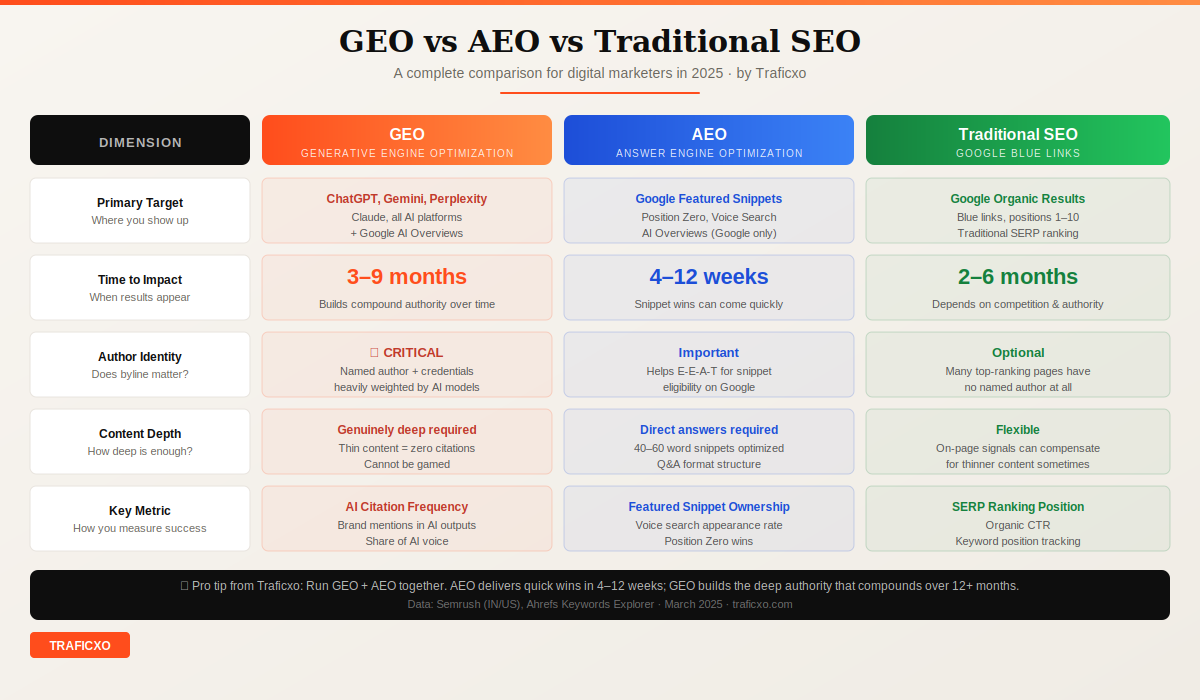
Short answer: no, but they are deeply connected. While GEO targets all AI engines — ChatGPT, Gemini, Perplexity, Claude — AEO specifically targets Google's featured snippets and voice search results. GEO builds authority over 3–9 months through expertise signals and citation PR. AEO can produce featured snippet wins in as little as 4–12 weeks by restructuring content around direct Q&A formats and implementing schema markup. Both share the same content quality foundation: direct answers, named authors, structured data, and specific verifiable claims. If you do AEO well, you almost automatically improve your GEO performance, and vice versa.
At Traficxo, we run both tracks in parallel. The AEO work gets quicker wins that demonstrate traction to stakeholders, while the GEO work builds the kind of deep authority that pays off over 6–18 months with compound returns.
GEO vs Traditional SEO: The Differences That Actually Matter
This comes up in almost every strategy call we run. Clients who have been doing SEO for years want to know: do I need to throw away what I've been doing?
Not throw away, but significantly evolve. The biggest shifts are these: Traditional SEO could be gamed with clever on-page optimization even when the underlying content was mediocre. GEO genuinely cannot. Author identity, which was often irrelevant in traditional SEO, becomes critical — AI models weight named, credentialed authors heavily. And the goal shifts from ranking #1 in Google's blue links to becoming the answer AI engines construct. If your content doesn't fully satisfy the reader's question, AI models will find a source that does, and that source will get the citation.
"The best GEO is just genuinely great content about something you actually know. The era of ranking tricks is over. The era of earned authority has begun."
How to Optimize Your Content for AI Engines: A Step-by-Step
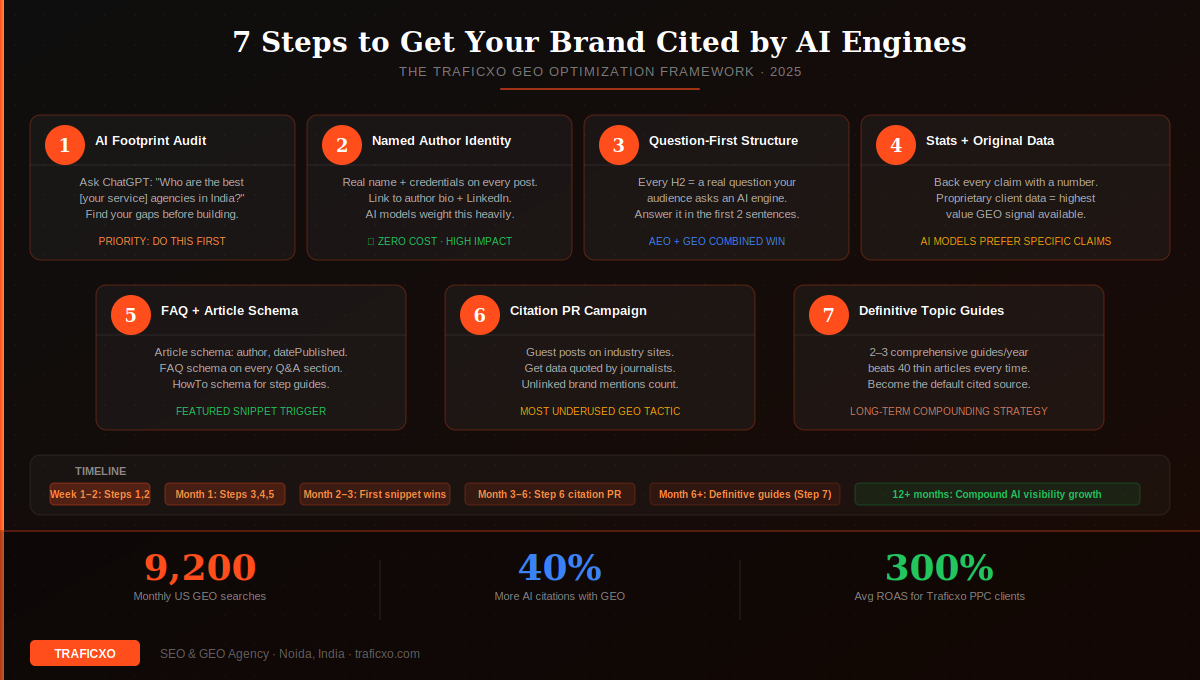
These are the exact steps we follow at Traficxo when optimizing a client's content for GEO and AEO performance.
Step 1 — Audit what you're already being cited for. Before creating anything new, find out if AI engines are already mentioning your brand. Go to ChatGPT or Perplexity and ask: "Who are the best [your service] agencies in [your city]?" The answers will reveal your current AI footprint and show where competitors are being cited instead of you.
Step 2 — Build real author identity into your content. Every article needs a named author with a bio that establishes genuine credentials. Not a generic "Team" byline — a real person whose name appears consistently across your content, with a linked LinkedIn profile and first-person experience signals in the writing.
Step 3 — Restructure your articles around complete questions. Map every major section of your content to a specific question your audience would ask an AI. Make sure the first 1–2 sentences after each heading directly answer that question. A user reading only those two sentences should walk away satisfied.
Step 4 — Add statistics, examples, and original data. AI models weight content that is specific over content that is general. Back up every key claim with a number, a study, or a real-world example. Original proprietary data from your client work is the highest-value GEO asset you can create.
Step 5 — Implement FAQ and Article schema markup. Structured data tells search and AI engines what your content is about in a machine-readable format. At minimum, every blog post should have Article schema with a named author, datePublished, and dateModified. Any piece that answers common questions should have FAQ schema.
Step 6 — Build brand mentions across authoritative third-party sources. Getting cited by AI engines isn't just about your own website. Pursue guest contributions on industry publications, get your data quoted by journalists, earn mentions in relevant roundup articles. Each unlinked brand mention in a credible source tells AI models that your brand is a real player in your space.
Step 7 — Publish definitive resource content on your core topics. AI models tend to cite the same handful of sources repeatedly for any given topic cluster. Your goal is to become one of those sources in your niche. One 3,000-word definitive guide that fully answers a topic will earn more AI citations than a dozen superficial articles on the same subject.
5 Mistakes That Keep Brands Invisible on AI Search
After running GEO and AEO campaigns for businesses across real estate, healthcare, SaaS, and e-commerce, these are the problems we see consistently.
Mistake 1: Treating GEO as a future problem
The brands building AI citations right now are the ones who will dominate when AI search usage fully matures. If you wait until it is more established, you will be playing catch-up against competitors who spent 18 months building authority.
Mistake 2: Publishing without named, credentialed authors
In a review of 30 Indian B2B company blogs, only 6 had named authors with linked bios on their posts. The other 24 were essentially anonymous to AI engines. Fix this before you do anything else — it costs nothing and takes an hour.
Mistake 3: Writing for search volume instead of semantic completeness
A 600-word article targeting "best SEO agency India" will not get cited by ChatGPT. A 2,500-word guide that genuinely explains what to look for when hiring an SEO agency — with real evaluation criteria, red flags, pricing expectations, and case study examples — will. Write for the person, not the keyword.
Mistake 4: Ignoring structured data
In our audits, we routinely find that fewer than 20% of blog posts have any structured data at all. Adding FAQ schema to your top 10 articles is a half-day project that can produce measurable snippet gains within weeks.
Mistake 5: Measuring success only by Google rankings
If your only KPI is "rank #1 for [keyword]" you will miss the value you're creating — or failing to create — on AI platforms. Start tracking how often your brand is mentioned when relevant topics are queried in ChatGPT and Perplexity. These are the metrics that will matter most by 2026.
What This Means for Indian Businesses in 2025
The Indian digital market is moving fast. Semrush data shows 2,000 monthly Indian searches for "generative engine optimization" — a figure that has nearly tripled in 12 months. More importantly, the competitive gap in India is wider than in Western markets. Most Indian digital agencies are still focused purely on traditional SEO metrics. Very few have built real GEO and AEO capabilities.
For Indian businesses targeting international clients in the US, UK, and Gulf markets, this gap represents a significant opportunity. If your brand shows up as a cited source when ChatGPT answers a question asked by someone in New York or London, that is a quality signal that no amount of traditional ranking can replicate.
The businesses that move on this now — that invest in author authority, structured content, semantic depth, and citation PR — will be the ones that competitors wonder about in two years, asking: "How did they get so visible so fast?"
Quick Action Summary
Add named authors to every blog post → Restructure your top 10 articles with Q&A sections → Add FAQ and Article schema → Publish one genuinely comprehensive guide on your most important topic → Start tracking your AI citation frequency monthly. These five things, done well, will put you ahead of 90% of your competitors.
Explore Related Services
Enterprise Technical SEO
Drive sustainable, high intent organic traffic and dominate search rankings with our advanced search engine optimization frameworks.
Accelerate organic growthData Driven Paid Advertising
Lower your customer acquisition costs and maximize return on ad spend with highly targeted Google and Meta PPC campaigns.
Scale your ROAS