It is 2026, and the browser address bar—often called the "omnibox"—is smarter than ever. Yet, a fundamental question remains for every internet user: Should you search for a website on Google, or type the URL directly?
The answer isn't just about preference; it’s about security, privacy, and speed.
Below is a comprehensive guide comparing these two methods, written for the modern web user.
Search Google or Type a URL: Which Gives Better Results?
We’ve all done it. You want to go to Amazon, so you type "amazon" into the address bar and hit Enter. Google Search loads, you click the first link, and then you’re there.
But did you know that when you Search Google or Type a URL, that extra step of searching might be exposing you to phishing scams, slowing you down, and leaking your data?
In 2026, the line between a "search engine" and a "browser" is blurrier than ever. AI-integrated browsers now predict where you want to go before you finish typing. However, understanding the mechanical difference between Direct Navigation (typing the URL) and Search Navigation (Googling it) is critical for your digital safety.
Would you like me to rewrite the rest of your article to include this keyword more naturally throughout the text?
The Core Difference: How They Work
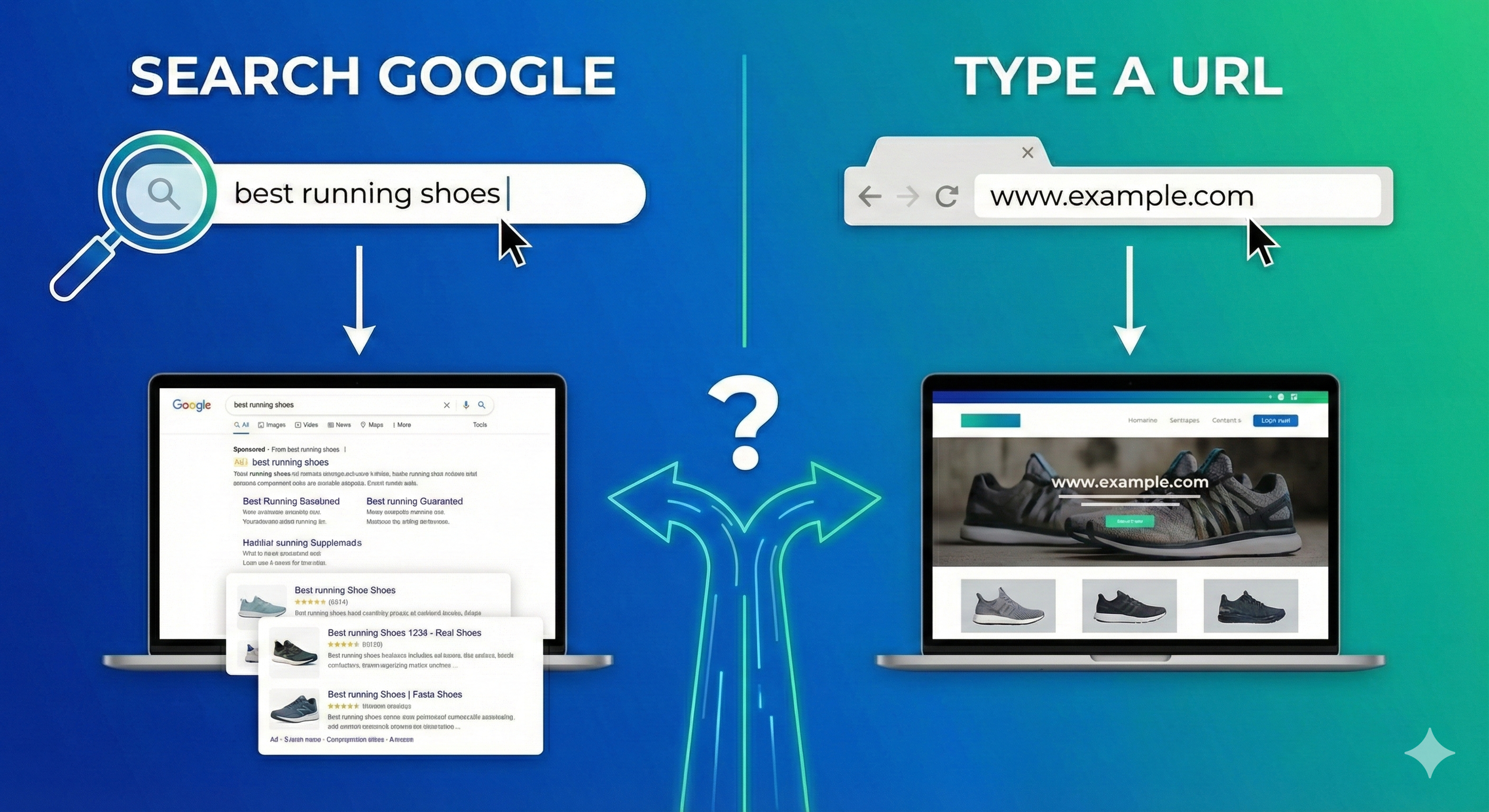
1. Typing the URL (Direct Navigation)
When you type nytimes.com and hit Enter, you are giving your browser a precise set of coordinates.
- The Mechanism: Your browser contacts a DNS (Domain Name System) server, which translates that text into an IP address (like 151.101.1.164).
- The Result: Your browser connects directly to that server. You bypass Google, Bing, or any other middleman.
- The Vibe: It’s like typing a friend's address into your GPS and driving straight to their driveway.
2. Searching Google (Search Navigation)
When you type "New York Times" and hit Enter (or click a suggestion that has a magnifying glass icon), you are asking a question.
- The Mechanism: Your browser sends that text to Google’s servers. Google’s algorithm runs a massive auction for ads and retrieves indexed pages it thinks are relevant.
- The Result: You see a Search Engine Results Page (SERP) filled with organic links, sponsored ads, and AI overviews. You must then choose which door to open.
- The Vibe: It’s like driving to the town square and asking a stranger, "Do you know where my friend lives?"
The Comparison: Speed, Security, and Privacy
Round 1: Speed and Efficiency
Winner: Type a URL
In 2026, speed is currency.
- Direct URL: Zero friction. You type, you arrive. If you use browser autofill (e.g., typing "y" and hitting enter for YouTube), it is instantaneous.
- Google Search: Requires a "middleman" step. You have to wait for the search results to load, scan the page, and click. Even with 5G or 6G speeds, that cognitive load adds up.
Round 2: Discovery and Research
Winner: Search Google
If you don’t know the exact destination, direct navigation is useless.
- The "I'm Feeling Lucky" Factor: If you are looking for "best Italian restaurant near me" or "how to fix a leaking tap," you must search. Typing bestitalianrestaurant.com will likely lead you to a parked domain or a spam site.
- AI Overviews: In 2026, Google’s AI snapshots often answer your question right on the results page, saving you from clicking any website at all.
Round 3: Security (The Phishing Trap)
Winner: It's Complicated (But mostly Typing URL)
This is the most critical section for your safety.
- The Search Risk (Malicious Ads): Attackers often buy ads on Google for keywords like "Coinbase login" or "Amazon support." If you search for these terms and absentmindedly click the first "Sponsored" link, you might land on a look-alike phishing site designed to steal your password.
- The Typosquatting Risk: If you try to type the URL but get it wrong (e.g., amazonn.com), you might land on a scam site. However, modern browsers (Chrome, Edge, Safari) now have built-in "typo protection" that warns you if you seem to be visiting a fake version of a popular site.
Round 4: Privacy
Winner: Type a URL
- Search: When you search "Facebook," Google logs that you are looking for Facebook. They add this to your profile to target you with ads later.
- Direct: When you type facebook.com directly, Google (the search engine) doesn't necessarily know you went there, unless you are using the Chrome browser or Google DNS. It cuts out one layer of tracking.
2026 Guide: When to Use Which?
To make this easy, I’ve created a decision matrix.
| Scenario | Recommended Action | Why? |
|---|---|---|
| Banking & Finance | Type the URL | Never search for "Bank of America login." Malicious ads target these searches heavily. Bookmark the official site or type it carefully. |
| Shopping (Specific Brand) | Type the URL | If you know you want Nike, go to nike.com. Searching exposes you to competitor ads and counterfeit stores. |
| Shopping (General) | Search Google | If you want "best running shoes 2026," search is your friend. You need the variety of reviews and comparisons. |
| Social Media | Type the URL | Typing "twitter" or "instagram" into Google every time is a waste of time. Let your browser autofill the URL. |
| Troubleshooting/How-To | Search Google | You need answers, not a specific homepage. |
Expert Tips for the "Hybrid" User
Most of us use the address bar for both. Here is how to master the "Omnibox" in 2026:
- Watch the Icons:
- If you see a Magnifying Glass next to your typing, you are about to perform a Google Search.
- If you see a Globe or a specific favicon (logo), you are about to visit a website directly.
- Use "Site Search" Shortcuts:
- In many browsers, you can type youtube.com and then press Tab. The bar will change to "Search YouTube," allowing you to search inside that site directly, skipping Google entirely.
- Trust, but Verify:
- If you type a URL, always glance at the lock icon 🔒 in the address bar after the page loads. Ensure it is the secure HTTPS version of the site you intended to visit.
Conclusion
Type the URL when you know your destination. It is safer, faster, and keeps your data more private.
Search Google when you are exploring, learning, or shopping around.
The "lazy" habit of Googling everything—even websites you visit daily—is a hard habit to break, but in an age of sophisticated ad scams, taking control of your navigation is one of the smallest, smartest security upgrades you can make.
Explore Related Services
Enterprise Technical SEO
Drive sustainable, high intent organic traffic and dominate search rankings with our advanced search engine optimization frameworks.
Accelerate organic growthData Driven Paid Advertising
Lower your customer acquisition costs and maximize return on ad spend with highly targeted Google and Meta PPC campaigns.
Scale your ROAS