Let's be honest. Most business owners who hand over their Google Ads account to an agency have one real question: Is my money actually being spent well?
Not "are they running campaigns." Not "are they sending me reports." But is someone, somewhere, genuinely working to squeeze the best possible return from every rupee or dollar going into that ad platform?
The answer depends entirely on which agency you pick, and more importantly, what they actually do once they're in.
This article breaks that down in plain language. No jargon. No fluff. Just a clear picture of what good Google Ads management looks like, what separates a strong agency from one that's quietly wasting your budget, and the questions you should be asking right now if you're not sure.
Why Google Ads Still Matters in 2026?
Before we get into what agencies do, it helps to understand why this channel still deserves serious attention.
Around 65% of businesses worldwide rely on Google Ads for their pay-per-click (PPC) campaigns. That's not a coincidence. The platform sits where buying decisions happen. Someone searches "best chartered accountant in Delhi" or "affordable legal services in Chicago" and the top results are ads. If you're not there, your competitor is.
On average, businesses earn $2 for every $1 spent on Google Ads, giving them a 200% return on investment. Now, that number sounds great on paper. The catch? That average hides a massive range. The top 10% of advertisers generate over 4x higher ROI than average. The gap between a well-managed account and a poorly-managed one is not small.
That's where proper Google Ads management comes in, and why choosing the right partner through a capable digital marketing agency matters more than most people realize.
What "Google Ads Management" Actually Means?
A lot of agencies use the phrase loosely. So let's define it properly.
Google Ads management refers to the ongoing work of building, running, optimizing, and reporting on paid search campaigns inside the Google Ads platform. It covers Search ads, Display ads, Shopping campaigns, YouTube video ads, Performance Max, and more.
A Google Ads management agency handles campaign strategy, keyword bidding, ad creation, and performance optimization for your paid search campaigns.
But here's the thing: setting up a campaign takes a few days. The real value of Google Ads management is in what happens after launch. That's where most agencies either earn their fee or quietly fail you.
What a Good Agency Actually Does Month After Month?
1. They Start With Conversion Tracking, Not Ads
This is the single biggest differentiator between agencies that get results and those that just "run campaigns."
A clear warning sign is an account that has been running for months where conversion tracking is absent, incomplete, or misconfigured. A "conversion" should represent a real business action: a form submitted, a phone call placed, a purchase completed. Not a visit to the homepage or a 50% scroll event.
Before a good agency writes a single ad, they make sure the tracking is airtight. They set up Google Tag Manager, connect it to Google Analytics, and verify that every lead or sale gets recorded properly. Without this, you're flying blind. You might be spending heavily on keywords that bring visitors but zero buyers, and you'd never know.
This is also why PPC services worth paying for always include a setup audit in the first few weeks.
2. They Do Keyword Research That Goes Deeper Than "Obvious" Terms
Anyone can find the obvious keywords in your industry. A strong agency looks further.
They analyze search intent, meaning they don't just find keywords with volume, they figure out what those searchers actually want. Someone typing "google ads cost" is probably doing research. Someone typing "google ads agency pricing for ecommerce" is close to buying. Those two searches need different ads and different landing pages.
Good agencies also build out negative keyword lists from day one. Audits across 184 Google Ads accounts found that 81% had the same foundational problems: broken tracking, search term waste, bidding mismatches, and misaligned landing pages. Search term waste is what happens when your ad shows up for irrelevant queries because no one took the time to exclude them.
This is not a one-time task. A serious agency reviews the search terms report weekly and keeps adding negatives throughout the campaign.
3. They Build Campaign Structure Around Your Business Goals
There's no such thing as a one-size-fits-all campaign structure. A solid SEO company in India or a growth-focused PPC agency in the US will tell you the same thing: structure depends entirely on your goals, your margins, and your customer journey.
For an ecommerce brand, that might mean separate campaigns by product category with tightly controlled Shopping feeds. For a law firm, it might mean one campaign per practice area with city-level targeting. For a SaaS company, it means separating brand keywords from non-brand terms so you can measure each correctly.
Today, Performance Max campaigns blend Search, Display, YouTube, Discover, Gmail, and Maps into a single AI-managed surface, and the agency's job is to build the asset library, conversion structure, and audience signals the model uses to decide where your money goes.
That last part is critical. AI campaigns like Performance Max are only as good as the inputs you feed them. A weak agency dumps a campaign into Performance Max and calls it "automated optimization." A strong agency builds a complete asset library, creates strong audience signals from customer data, and monitors asset performance regularly to pull underperforming creative.
4. They Write Ads That Connect With Real People
Ad copy is often treated as an afterthought. It shouldn't be.
Your headline is the first thing a potential customer reads. It has to earn the click. That means speaking to the specific problem someone is searching about, not just listing your company name and a generic CTA.
Good agencies write multiple headline variations, test them against each other, and rotate them systematically. They look at which messages get the best click-through rate versus which ones convert best after the click. Those two things are not always the same ad.
They also think about the full journey. The ad has to match the landing page. If your ad says "50% off on annual plans," the landing page the user lands on better lead with that offer immediately. Disconnect between ad and landing page is one of the most common causes of wasted spend.
5. They Manage Bids Strategically, Not Passively
Smart Bidding can reduce CPA by up to 30%. But automated bidding is not the same as set-it-and-forget-it. Google's bidding algorithms need correct conversion data to optimize well, and they can go off track without human oversight.
A good agency monitors bid performance constantly. They set appropriate target CPA or ROAS goals based on your actual business numbers, not industry averages. They raise bids on high-converting audience segments and pull back on wasted spend. They also know when to override automation, particularly in volatile market periods or around product launches.
Agencies that optimize weekly, checking performance, adjusting bids, testing new ad copy, and refining targeting, consistently outperform those doing monthly check-ins.
6. They Send Reports That Tell the Truth
This is where a lot of agencies lose trust. A report full of impressions, click-through rates, and average position numbers might look impressive. But none of those metrics pay your bills.
If the first page is dominated by impressions, clicks, and click-through rate without any connection to actual business outcomes, you are looking at a report designed to look impressive rather than be useful.
A proper monthly report from a good agency covers: total spend, leads or sales generated, cost per lead or cost per acquisition, what was changed in the account that month, and what will be tested next.
That last point matters. Good agencies tell you their plan. They don't just document what happened; they tell you what they're doing about it.
7. They Stay Current With Platform Changes
AI Max for Search, the Power Pack framework (PMax plus AI Max plus Demand Gen), expanded Performance Max controls, Ads Advisor, brand guidelines, creative asset tools, and ads in AI Overviews all launched or significantly updated in 2025. If your agency has not proactively discussed how these changes affect your account and whether you should be testing any of them, they are not keeping up with the platform.
Google's platform changes faster now than it ever has. An agency that ran solid campaigns in 2022 but hasn't updated their approach since may be burning your budget using outdated tactics. Ask your agency point blank: what has changed in how you manage campaigns in the last 12 months?
What Separates Mediocre Agencies From Great Ones?
Here's a direct comparison of what good looks like versus what you often actually get.
Budget Allocation A good agency puts the majority of budget toward proven, high-intent keywords and pulls spend from campaigns that aren't converting. A mediocre one runs broad match terms across large audiences, inflates click volume, and shows you "growth" in traffic that never turns into revenue.
Negative Keywords A good agency reviews the search terms report weekly and blocks irrelevant queries before they waste budget. A mediocre one never touches negatives after the first month.
Ad Testing A good agency runs structured A/B tests and documents what worked and why. A mediocre one runs the same ads for six months.
Conversion Tracking A good agency ensures every real business action is tracked accurately and cross-checks Google Ads data against your CRM or backend. A mediocre one uses Google's auto-conversion suggestions, which often count things like sitelinks and form opens as conversions.
Communication A good agency flags problems before you ask and proposes solutions. A mediocre one waits for your monthly call and reassures you that "the campaigns are optimizing."
The Real Cost of Bad Google Ads Management
Another study of 60-plus accounts revealed that 25-40% of budget was wasted due to incorrect conversion signals.
Think about what that means in real numbers. If you're spending $5,000 a month on ads, a poorly set up account could be burning $1,250 to $2,000 every single month on signals that don't reflect real results. Over a year, that's $15,000 to $24,000 gone.
Choosing the right agency partner is a strategic business decision. The wrong choice costs more than the management fee.
This is why businesses that work with an experienced SEO company in India or a dedicated PPC services team often see dramatically different results than those who pick the cheapest option available. The management fee is not the cost. The cost of bad management is the wasted ad spend you never got back.
What Good Google Ads Management Pricing Looks Like?
Pricing models vary. Here's what the market looks like right now.
US management fees typically run $1,000 to $5,000 per month or 10 to 20% of ad spend. A practical benchmark: expect to spend between $1,500 and $5,000 per month on management fees for a mid-market Google Ads account with a monthly ad budget of $10,000 to $50,000. Accounts with more complex structures, multiple regions, or ecommerce feeds will sit at the higher end of that range.
There are three main pricing models:
Flat Monthly Fee -- You pay the same amount regardless of what you spend on ads. This works well when your budget is stable and you want predictable costs. The downside is the agency doesn't have a direct financial incentive to grow your spend.
Percentage of Ad Spend -- The agency charges 10 to 20% of whatever you spend on ads. Percentage-of-spend billing creates a potential conflict: agencies might push you to spend more on ads even when it's not in your best interest. Every dollar you cut from wasteful campaigns reduces their commission, so real budget optimization can work against their revenue model.
Performance-Based -- Less common, but this ties some portion of the fee to actual results. This aligns incentives well but requires clean tracking to work fairly.
The right model depends on your situation. Whatever you choose, make sure the scope of work is documented clearly in writing: what's included, what's not, who owns the account, and how reporting works.
The Role of Growth Optimization in Google Ads
Most people think of Google Ads purely as a traffic channel. The best agencies treat it as a growth optimization lever.
That means looking at the full funnel, not just what happens before the click. What does your landing page do with the traffic it receives? What's the offer? Is the form too long? Do users drop off on mobile?
Budget waste occurs when campaign targeting isn't aligned with customer intent, conversion tracking is missing, or ads hit irrelevant target audiences.
A growth-focused agency will flag landing page problems even though fixing them isn't strictly their job. They understand that improving your conversion rate from 2% to 4% effectively doubles the value of every dollar you spend on ads, without spending more. That's growth optimization in action.
Some full-service digital marketing agencies also layer in SEO services alongside PPC, so the insights from paid campaigns (what keywords convert, what copy resonates, which audiences are most valuable) feed into organic strategy. When both channels inform each other, you get compounding results that neither delivers alone.
How Video Services Fit Into Google Ads Strategy?
One area that gets underutilized in most accounts is YouTube advertising through video services. Many brands still think of YouTube as a brand awareness channel with no direct ROI.
That's an outdated view.
Including a voice-over in Google ads can increase ad recall by 25% and lower the cost per lifted user by 50% compared to regular advertisements. YouTube's targeting capabilities now rival Search in terms of precision. You can target people who have watched competitor content, visited your website, or fall into specific in-market categories.
Video campaigns also feed into the Performance Max asset mix. An agency that brings strong video services alongside its PPC work can build campaigns that work across multiple touchpoints, from the initial YouTube pre-roll that builds awareness to the retargeting search ad that closes the sale.
Red Flags: What Bad Google Ads Management Looks Like
Knowing what good looks like is helpful. Knowing what bad looks like is protective.
Watch for these warning signs:
You don't own your account. A legitimate agency builds campaigns inside your Google Ads account, not their own. If they won't provide ownership access, your data and campaign history leave with them if you ever switch.
They guarantee results. No agency can guarantee specific ad positions, click volumes, or conversion rates. The Google Ads auction is dynamic. Promises of guaranteed results are a sign of either inexperience or dishonesty.
Reports are full of vanity metrics. Impressions and CTR look nice in a slide. Ask for cost per lead or cost per sale instead.
The account barely changes. A PPC strategist recently noted that if you look at an agency's change history and most entries are tiny bid adjustments, you are likely getting fluff. Activity is not strategy. Busywork is not management.
They push budget increases without justification. Any recommendation to increase spend should come with data showing why more budget would generate proportional returns.
Tracking is broken or missing. This one is non-negotiable. With Google's 2026 privacy-compliant shifts demanding first-party data preparation, agencies that ignore cookieless tracking create major attribution blind spots. Poor setup means you cannot connect ad clicks to closed revenue.
Questions to Ask Any Agency Before You Sign
Before you commit, run through these:
- Will I have admin access to my own Google Ads account at all times?
- How do you define a "conversion" and how do you set up tracking?
- How often do you review and update the negative keyword list?
- Can you show me examples of monthly reports you send existing clients?
- How have your strategies changed in the last 12 months given Google's updates?
- Who specifically will be managing my account day to day?
- What's your process when a campaign isn't performing?
A confident, capable agency will answer all of these without hesitation. Vague answers, deflections, or "we use a proprietary system" to explain away lack of transparency are all reasons to keep looking.
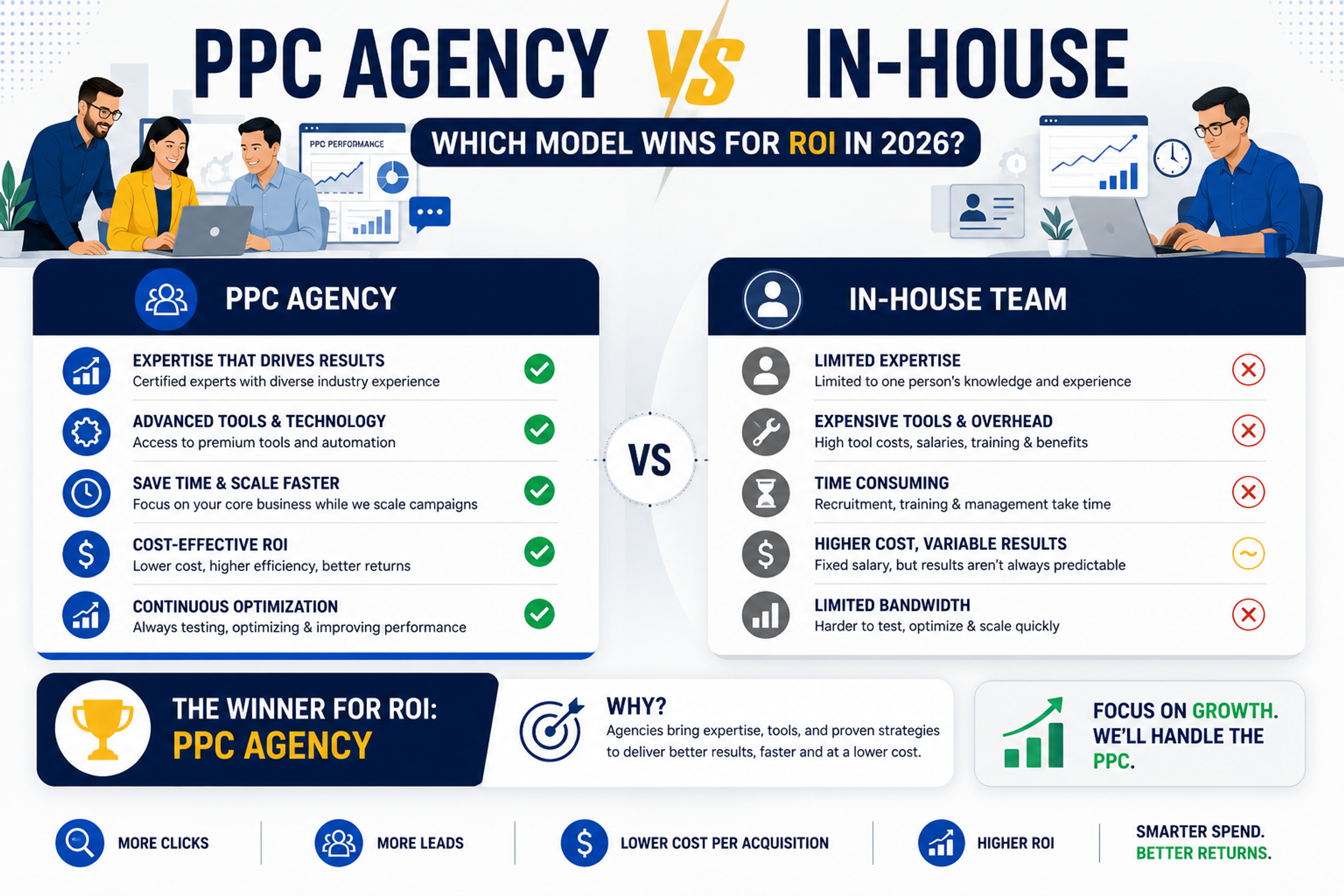
When You Should Consider a Digital Marketing Agency Over a Freelancer?
For straightforward, small accounts with simple goals, a freelancer can work well. But as your business grows, the case for partnering with a full-service digital marketing agency gets stronger.
An agency brings a team. That means a strategist thinks about your campaigns at the account level, a copywriter handles ad creative, an analyst works the data, and a developer fixes landing page issues. You also get institutional knowledge: the team has seen similar challenges across many accounts and industries.
For businesses targeting multiple locations, running multiple product lines, or wanting to layer SEO services on top of paid campaigns, an agency's depth of resources is hard to match with a single freelancer.
The best agencies, whether you're looking for PPC services in India or a growth optimization partner in the US, operate as an extension of your marketing team. They're proactive, transparent, and focused on your business outcomes rather than their own metrics.
Conclusion:
Good Google Ads management is not about running campaigns. It's about understanding your business, tracking what actually matters, testing constantly, and making data-driven decisions that improve results over time.
The best Google Ads management is the one that creates transparent, measurable, profitable growth without forcing you to guess what is being done, what is being billed, or whether your budget is actually working.
Whether you're a startup looking at PPC services for the first time, or an established company re-evaluating your current digital marketing agency, the standard you should hold any agency to is simple: can they explain clearly what they're doing, why it's working, and what they'll do when it isn't?
If yes, you have a real partner. If not, your budget deserves better.
Explore Services & Solutions
PPC Services Hub
Access our comprehensive vertical strategies, core processes, and expert resources.
View service hub Specialized SolutionGoogle Ads Management
Maximize your advertising return and lower acquisition costs with expert PPC management.
Learn moreReady to grow your digital presence?
Connect with our execution specialists for a customized roadmap.