Marketing teams love WordPress because it is familiar. You can buy a premium theme, install twenty different plugins, and launch a landing page in an afternoon.
But there is a hidden cost to that convenience.
By the time a B2B software company scales to a million dollars in revenue, their WordPress site is usually a technical disaster. The database is bloated. Third-party tracking scripts fight with page builders. Search Console is flashing red warnings about Core Web Vitals. Your pages take five seconds to load on mobile devices.
If your website is slow, your buyers will not wait around to read your case studies. They will close the tab and book a demo with your competitor.
Migrating from WordPress to Next.js is the most effective way to permanently fix your site speed and technical SEO. Here is exactly why B2B brands are abandoning traditional monolithic websites and how you should handle the transition.
Why Traditional WordPress Fails at Scale
The core problem with WordPress is how it renders information. Every time a user visits a page, the server has to query the database, process PHP scripts, and stitch the HTML together before sending it to the browser.
You can try to mask this latency with aggressive caching plugins. However, the moment you introduce dynamic elements like personalized pricing calculators or gated B2B content, those caching layers break down.
Add the visual bloat of page builders like Elementor or Divi, and you end up serving massive JavaScript files that block the main thread. Your Largest Contentful Paint (LCP) suffers. Your organic search rankings drop. Your Google Ads cost-per-click increases because your landing page experience is rated poorly.
The Headless Next.js Solution
You do not actually have to throw away WordPress completely.
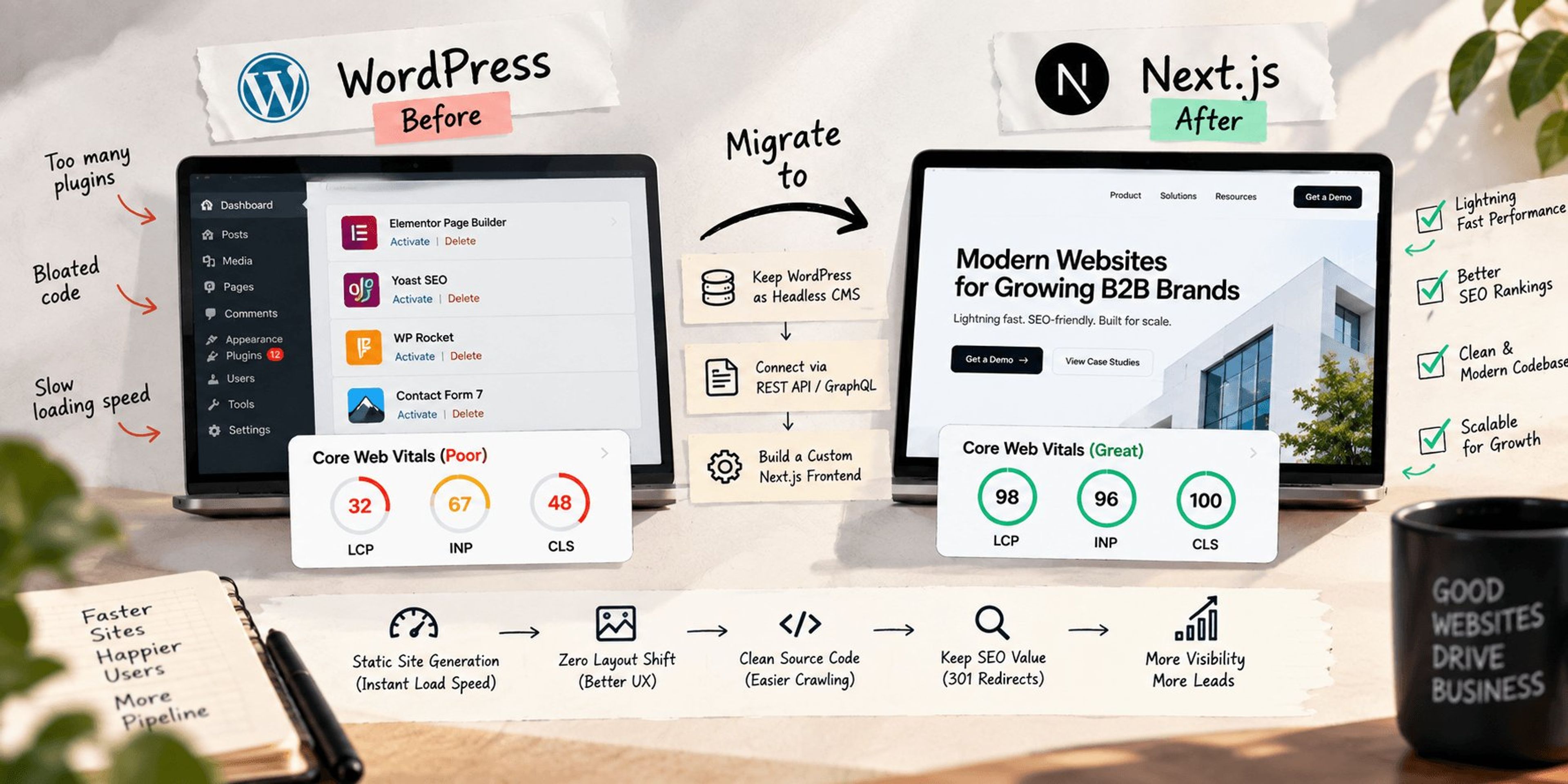
The smartest migration strategy is a "headless" architecture. You keep WordPress installed on a secure server to act purely as a backend database. Your marketing team can still write blog posts in the familiar Gutenberg editor.
But instead of letting WordPress generate the front-end design, we disconnect it. We build a completely custom, lightning-fast frontend using Next.js. The Next.js application pulls your content from WordPress via a REST API or GraphQL and serves it to your users.
This gives you the best of both worlds. The marketing team keeps their workflow intact, and the engineering team gets a modern React framework.
Want to see the performance difference? Review our Next.js web development solutions for B2B brands.
The Technical SEO Advantages of Next.js
Moving to Next.js gives you granular control over exactly what search engine crawlers see.
- Static Site Generation (SSG): Next.js can pre-build all your marketing pages into static HTML files during the deployment process. When a user clicks your link in Google, the page loads instantly from a global CDN. The server does no heavy lifting.
- Zero Layout Shift (CLS): WordPress themes often load fonts and images poorly, causing the text to jump around as the page renders. The Next.js <Image /> component forces developers to define exact dimensions, completely eliminating Cumulative Layout Shift.
- Clean Source Code: You eliminate the thousands of lines of unused CSS and JavaScript that WordPress themes inject into every page. Search engines can crawl your primary keywords and schema markup instantly.
Site speed is a direct ranking factor. Learn how our Technical SEO team audits web architecture to identify revenue leaks.
Managing the Migration Risk
A platform migration is the most dangerous event in SEO. If you execute it poorly, you will destroy years of organic traffic.
We treat website migrations as surgical procedures. Before writing a single line of Next.js code, you must map every existing WordPress URL.
You need a comprehensive 301 redirect matrix to ensure every old blog post points to the correct new URL. You must migrate all your title tags, meta descriptions, and image alt text identically. You also need to run aggressive staging environment tests to ensure your server-side rendering is functioning properly before pushing the new architecture live.
If you skip these steps, Google will drop your domain from the index.
Stop Losing Leads to Slow Load Times
A website that takes four seconds to load converts at roughly half the rate of a site that loads in one second.
You spend thousands of dollars a month on PPC campaigns and SEO content to drive B2B buyers to your domain. Letting them bounce because of outdated WordPress architecture is a massive waste of capital.
Upgrading your digital infrastructure requires an upfront investment, but the resulting increase in pipeline velocity pays for the migration in months.
Ready to fix your site speed permanently? Book a Web Dev Consultation today. We will audit your current WordPress setup and give you a realistic timeline for a Next.js upgrade.
Explore Services & Solutions
Web Development Hub
Access our comprehensive vertical strategies, core processes, and expert resources.
View service hub Specialized SolutionWordPress Development Services
Build blazing-fast, high-converting custom WordPress and Next.js digital platforms.
Learn moreReady to grow your digital presence?
Connect with our execution specialists for a customized roadmap.