If you asked an SEO professional in 2015 what their biggest job was, they would have said "get the right keywords on the right pages." That answer is not wrong today, but it barely scratches the surface of what search optimization has become.
AI SEO is not a trend anymore. It is the new standard. Search engines are smarter, users are more demanding, and the bar for ranking on page one is higher than it has ever been. Whether you run a startup, work at a Digital Marketing Agency, or manage SEO services for a large enterprise, understanding how artificial intelligence is reshaping search is no longer optional. It is a survival skill.
This guide breaks down everything you need to know, from what AI SEO actually means to how it affects keyword research, content, technical performance, PPC Services, Video Services, and business growth. We have also included data from the most recent industry studies so you are not working on guesswork.
What Is AI SEO? (A Clear, No-Jargon Answer)
AI SEO is the use of artificial intelligence technologies, including machine learning, natural language processing (NLP), and large language models (LLMs), to plan, execute, and improve your search engine optimization strategy.
But here is the part most guides skip over: AI SEO works in two directions.
First, AI tools help marketers do SEO tasks faster and smarter. Keyword research that once took days now takes hours. Content briefs that used to require a strategist can be generated in minutes. Technical audits that needed a developer can now be flagged automatically.
Second, and this is the bigger shift, the search engines themselves are using AI to understand what your content means and who it is for. Google is not just matching keywords anymore. It is reading your page the way a person would, deciding if it actually answers a question, and then choosing whether to surface it in search results, or increasingly, inside an AI-generated answer at the top of the page.
AI SEO marks a fundamental change from reactive to proactive strategies. SEO experts used to study algorithms, make changes, and wait for results. Now, AI SEO uses predictive analysis and real-time data that adapts to search engine updates and user behavior.
A Quick Look Back: How AI Entered Search
To understand where things stand today, it helps to know where this started.
Google has been using AI in its algorithm for over a decade. Each major update brought a smarter system:
RankBrain (2015): This was the first time Google officially used machine learning to interpret search queries. RankBrain helps interpret search queries, especially those it has never seen before, while BERT focuses on understanding the nuances and context of the words in a search query.
BERT (2019): With BERT, Google moved from matching words to understanding meaning. A search for "can you get medicine for someone at a pharmacy" finally understood the word "for" mattered, and that the searcher was asking about picking up a prescription for another person.
MUM and Gemini (2021 to present): Google's newer models can understand text, images, video, and audio all at once, comparing information across dozens of languages before generating an answer.
AI Overviews (2024 to present): This is the feature that changed everything for SEO professionals. Google's AI Overviews have become the most significant change to search results since featured snippets. Two billion monthly users engage with AI Overviews across 200+ countries and 40 languages.
The story of AI in search is not one big moment. It is a series of steps, each one making the system harder to fool and more rewarding for publishers who create genuinely useful content.
The Numbers That Tell the Real Story
Before we get into strategy, let us look at the data. Because the scale of what is happening in AI SEO is something you need to see in numbers to fully appreciate.
67% of SEO professionals see AI as a critical factor in future search engine algorithms. 63% of websites using AI for SEO reported improved rankings within three months. 45% of enterprise-level companies use AI for real-time SEO monitoring and adjustments.
AI-driven SEO campaigns can lead to a 45% increase in organic traffic and a 38% increase in conversion rates for e-commerce websites. 83% of SEOs from organizations with over 200 employees reported an improvement in their SEO performance following the integration of artificial intelligence.
AI tools can improve SEO rankings by 49.2% when used strategically. 86% of SEO professionals have integrated AI into their strategy. 87% of marketers use AI to assist content creation.
Now here is the flip side:
Organic CTR dropped 61% for queries where AI Overviews appear, from 1.76% to 0.61% over 15 months. When a Google AI summary appears, users click an external link 8% of the time, versus 15% when no summary is present.
This is the paradox of AI SEO in 2026. More people are searching. AI is getting better at finding your content. But fewer of them are clicking through to your website because AI answers the question before they need to. Understanding this tension is the key to building a strategy that actually works.
How AI Is Changing Every Core Area of SEO?
1. Keyword Research Is Smarter (and Faster)
Old keyword research meant plugging terms into a tool, filtering by volume and difficulty, and picking a list. It worked well enough for a long time.
AI tools can reduce the time spent on keyword research by 80% and boost content optimization efficiency by 30%.
Today, AI-powered keyword tools do not just find keywords. They map out what a user actually wants when they type something in. They cluster related terms, identify questions that your audience is asking, spot long-tail opportunities your competitors have missed, and predict which terms are going to grow in the next three to six months.
AI-powered platforms process massive datasets taken from SERPs, social media, forums, and news sources to identify what users are searching for, how they phrase their queries, and what kinds of content they engage with. This allows marketers and SEOs to pinpoint relevant keywords at various stages of the search funnel.
For any business working with a SEO company in India or elsewhere, this means less time in spreadsheets and more time making decisions based on what the data is actually saying.
2. Content Creation and Optimization
Content is still the biggest lever you have in SEO. But how you create and optimize it has changed significantly.
Right now, 51% of marketing teams use AI to optimize content, and 50% create content with artificial intelligence. AI tools help 41% of marketers analyze their data.
What does this look like in practice?
AI tools now help writers understand what topics need to be covered in an article, how deeply each section should go, what questions users expect to be answered, and where the semantic gaps are compared to top-ranking pages. This does not replace the writer. It gives them a better brief before they start.
The important distinction is that AI helps you build a structure and find the right topics. The voice, the experience, the real-world examples, and the human perspective still have to come from a person. 67% of businesses report improved content quality when using AI. But that is content quality with a human editor at the wheel.
For SEO services teams, this means being able to scale content production without sacrificing quality. A topic cluster that once took three months to build can now be planned and briefed in weeks.
3. Technical SEO Gets Automated
Technical SEO has always been the part of the job that required deep expertise and a lot of manual work. Crawl errors, page speed issues, duplicate content, broken internal links, schema markup problems, Core Web Vitals failures. The list of things to check never ends.
AI tools are changing this by automatically crawling sites, flagging issues, prioritizing fixes by impact, and in some cases suggesting the exact code changes needed.
AI can analyze thousands of pages and automatically generate tailored content briefs, helping teams optimize massive content libraries with speed and consistency that would be impossible to achieve manually.
This is especially valuable for large websites. An e-commerce site with 50,000 product pages simply cannot be manually audited every month. AI makes continuous technical monitoring possible at a scale that was not realistic before.
For any serious SEO company in India or a global Digital Marketing Agency, automated technical auditing is now a baseline expectation, not a premium service.
4. Link Building and Authority Signals
Backlinks are not dead. But how AI SEO tools approach link building is different from the old "reach out to 200 people and hope for 5 replies" method.
AI-powered platforms can quickly analyze large sets of competitor backlink profiles to uncover patterns in referring domains, anchor text usage, and content formats that attract links. By training on historical link-building data, these tools can predict which sites are most likely to respond positively to outreach.
More importantly, AI has shifted what authority even means in search. Branded web mentions have the strongest correlation (0.664) with AI Overview appearances, much higher than backlinks (0.218).
This means that if you want to appear in AI-generated answers, the most important signal is not the number of backlinks pointing to your site. It is how often your brand is mentioned across the web in a context that establishes your credibility.
Getting mentioned in industry publications, forums, review sites, and news outlets is now directly tied to AI SEO performance. This is a fundamentally different game, and most businesses have not updated their off-page strategy to reflect it.
5. AI SEO and Video Services
This is one of the biggest gaps we see in most AI SEO guides, and it is something your strategy cannot afford to ignore.
Video is now a significant search surface. YouTube is the second-largest search engine in the world. Google regularly surfaces video results for how-to queries, product comparisons, and informational searches. And AI is changing how video content gets discovered.
1 in 3 marketers use AI to generate short-form videos, showing AI's growing role in Video SEO optimization.
AI tools now help with video transcription and auto-captioning, which gives search engines text to crawl. They assist with title and description optimization based on what is actually being searched. They identify timestamps and chapter markers that improve user experience and make videos more likely to be featured in search results.
For businesses that invest in Video Services, this means your video content needs to be treated with the same SEO rigor as your written content. Title tags, descriptions, transcripts, structured data, and thumbnail optimization all play a role in how well your videos rank.
Brands that combine strong written content with optimized Video Services are building a search presence that is significantly harder for competitors to displace.
The Rise of GEO: Generative Engine Optimization
This is the newest concept in AI SEO, and it is one that not enough businesses are thinking about yet.
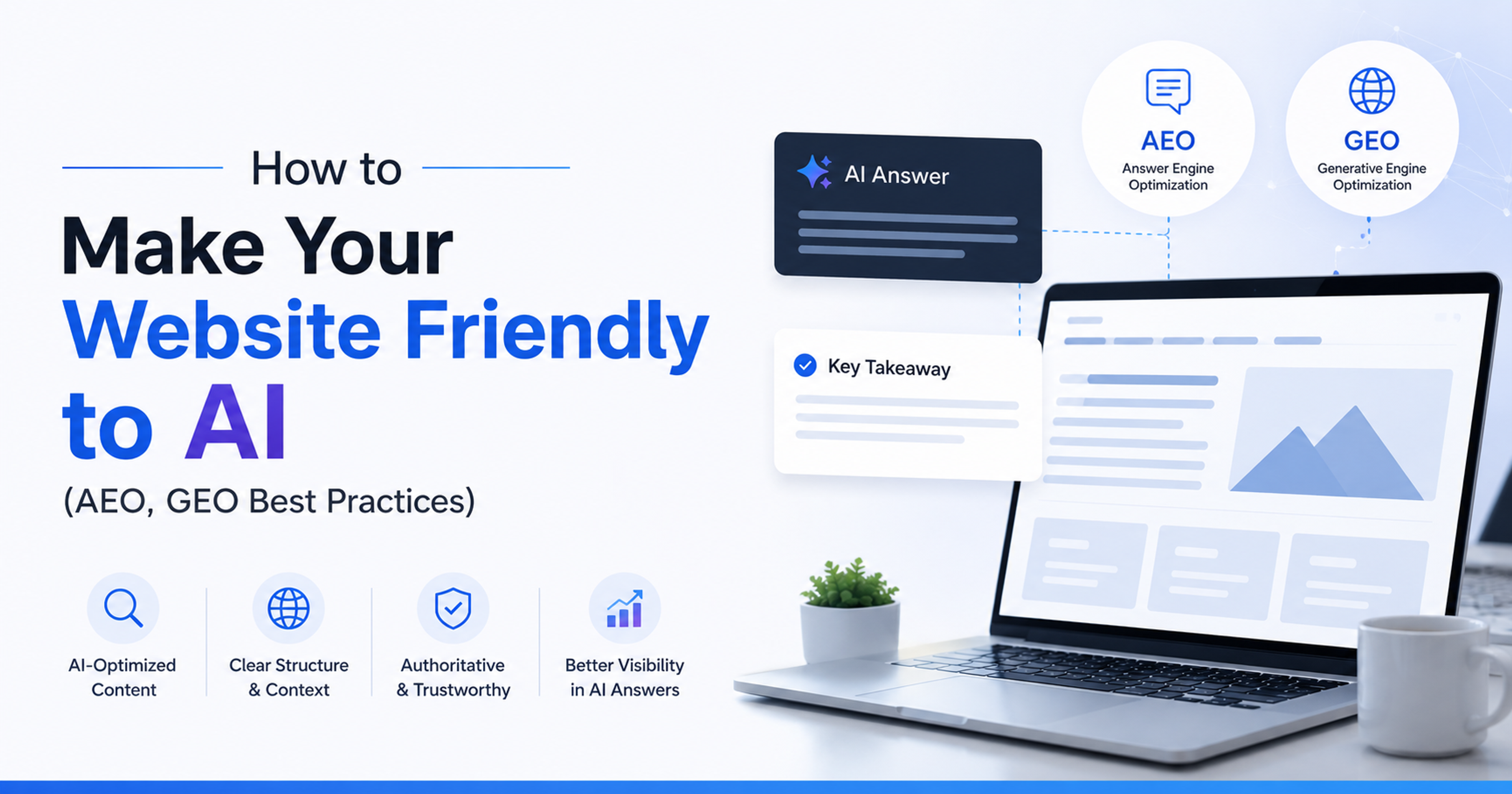
GEO, or Generative Engine Optimization, refers to the practice of optimizing your content so that it gets picked up and cited by AI-generated search answers. Not just Google's AI Overviews, but also ChatGPT, Perplexity, Microsoft Copilot, and any other AI tool that retrieves information from the web.
The GEO market size was $886 million in 2024 and is projected to reach $7.3 billion by 2031, a 34% compound annual growth rate. GEO delivers 4.4x higher conversions than traditional SEO. ROI of $3.71 per $1 invested in GEO optimization.
Here is why this matters. When an AI tool answers a question, it is picking sources it considers authoritative, clear, and well-structured. If your content is cited, even users who never click through to your site are seeing your brand name. And the users who do click are pre-qualified in a way that organic search visitors rarely are.
AI-referred visitors convert 23x higher than organic search visitors. B2B SaaS companies report 6x to 27x higher conversion rates from AI traffic versus traditional search. AI referral visits have 27% lower bounce rates and longer session durations.
The volume is still small. But the quality of this traffic is extraordinary, and it is growing fast.
LLM traffic rose from about 17,000 to 107,000 sessions when comparing January-May 2024 with the same period in 2025. Some sites are now reporting over 1% of total sessions coming from platforms like ChatGPT, Perplexity, and Copilot.
What the "Great Decoupling" Means for Your SEO Strategy
You might have seen the term "The Great Decoupling" in recent SEO discussions. It refers to a disconnect that has been growing over the past two years.
AI Overviews are reducing website clicks by over 30%, even as visibility increases. This shift, often called "The Great Decoupling," highlights the gap between rising impressions and declining traffic.
In plain terms: your content is being seen by more people, but fewer of those people are visiting your website because AI is answering their questions directly on the search results page.
For SEOs and marketers, optimising purely for clicks is a losing strategy. You also need to earn visibility where users now stop their journey, think answer boxes, snippets, and increasingly, AI summaries. The "clickless web" is accelerating.
This does not mean SEO is dying. It means the goal of SEO is evolving. Your content strategy should aim to:
- Rank in traditional organic results for clicks and conversions
- Get cited in AI Overviews for brand visibility
- Appear in LLM responses like ChatGPT and Perplexity for authority building
- Dominate featured snippets and People Also Ask boxes for quick wins
Brands cited in AI Overviews earn 35% more organic clicks and 91% more paid clicks than non-cited brands.
That last number is worth sitting with. Being in an AI Overview does not kill your clicks. For well-known brands, it actually drives more of them.
AI SEO and PPC Services: Why They Now Work Together?
One of the most underappreciated angles in AI SEO is how it is changing the relationship between organic and paid search.
In March 2025, Google Ads appeared on 5.17% of search results pages that also had an AI Overview. By October 2025, that number was 25.56%, a 394% increase in eight months. Google is actively monetizing AI Overviews by layering paid ads alongside them.
This means that as organic clicks shrink on AI-heavy searches, paid search is filling the gap right next to the AI-generated answers. PPC Services teams and SEO teams that operate in silos are leaving significant opportunity on the table.
When your brand is mentioned in an AI Overview and also appears in the paid results directly below it, the combined visibility is powerful. The organic citation builds trust. The paid ad captures the user who is ready to act.
Smart businesses are now using AI tools to coordinate keyword strategy across both channels. Identifying the queries where AI Overviews appear, assessing whether organic ranking is feasible, and deciding where PPC Services should fill the gap is a decision process that AI can help automate at scale.
For any Digital Marketing Agency managing both SEO services and PPC Services for clients, this integration is no longer a nice-to-have. It is core to getting the best results from both channels.
Growth Optimization in the Age of AI SEO
Growth Optimization as a discipline is about finding the fastest, most efficient ways to grow a business online. AI SEO sits at the center of that because search is still one of the highest-intent channels available to marketers.
But Growth Optimization with AI SEO is different from what it used to be. It is less about chasing rankings and more about building a presence that compounds over time.
Here is what a modern growth-focused SEO approach looks like:
Brand mentions over backlinks. As we covered above, AI systems respond to how often and in what context your brand is mentioned across the web. A strong brand mention strategy, including PR, digital partnerships, and community presence, now feeds directly into AI search visibility.
Topic authority over individual pages. AI systems prefer sources that demonstrate deep knowledge of a subject area. Building a complete topic cluster, covering every angle of a subject your audience cares about, signals that your site is a credible source worth citing.
Content freshness matters. Some models demonstrate a clear bias towards content freshness. Content depth, including sentence and word counts, and readability matter most for securing AI mentions and citations, while traditional SEO metrics like traffic and backlinks have little impact.
Structured content wins citations. Q&A formats, FAQs, numbered lists, and clear definitions are the structures that AI systems are most likely to extract and surface. Writing for clarity and scanability is now also writing for AI extraction.
AI SEO in India: A Growing and Competitive Market
The SEO market in India is growing at a pace that few markets in the world can match. AI adoption has gone global, but usage is not evenly distributed. The US leads, but fast-growing markets like India and Brazil are catching up quickly.
For businesses looking for a SEO company in India, or for Indian agencies building their own AI SEO capabilities, this is a significant moment. Local market dynamics create both an opportunity and a challenge.
On one hand, AI tools have democratized access to SEO capabilities that were previously only available to large agencies with big budgets. A well-resourced SEO company in India can now deliver the kind of data-driven strategy and execution that was once the exclusive domain of Western agencies.
On the other hand, competition for visibility in AI-powered search is intensifying. The brands that are moving quickly to build GEO-ready content, structured data, and authority signals will capture the AI-era opportunities. The ones waiting for the landscape to "settle" are ceding ground they will struggle to get back.
AI Mode has 100 million monthly active users in the US and India, which tells you that Indian users are already engaging with AI-powered search at scale. Any business serving Indian audiences needs to be optimizing for this.
What Competitors Are Missing: Gaps in the Current Conversation?
After analyzing the top-ranking content on this topic, here are the critical areas that most AI SEO articles do not address deeply enough.
They talk about AI tools but not AI strategy. Most articles list tools like Surfer SEO, Semrush, or Clearscope without explaining how to use them together within a coherent growth strategy. Tools do not win. Strategy wins.
They ignore the PPC and organic integration opportunity. The rise of AI Overviews has changed the economics of both paid and organic search. Almost nobody is writing about how SEO services and PPC Services teams need to work together in response.
They skip Video Services almost entirely. Video is a massive search surface and AI is changing how video content is discovered. This is a real opportunity that most businesses are leaving on the table.
They do not explain what to measure anymore. When clicks are down but brand visibility is up, how do you report on success? Most AI SEO content skips this measurement challenge entirely.
The answer to that last point: your reporting needs to include AI citation tracking alongside traditional metrics. Ranking position, organic traffic, and conversions still matter. But you also need to be tracking how often your brand appears in AI-generated answers, which sources are citing you, and whether that presence is growing over time.
Practical Steps to Improve Your AI SEO Right Now
You do not need to overhaul your entire strategy overnight. These are the highest-impact things you can do today.
Audit your content for clarity and structure. Go through your most important pages. Does every page answer a clear question? Does it have a logical structure with proper headings? Can you extract a clean, self-contained answer from the first two paragraphs?
Add FAQ sections to key pages. Structured data and schema markup, including FAQ and HowTo formats, is increasingly important for AI SEO, which means optimizing for AI search results. FAQs are one of the most reliable ways to get your content surfaced in AI-generated answers.
Build topical depth, not just page count. Create content clusters that cover a subject completely. One well-developed topic cluster will outperform ten thin, isolated articles in AI-era search.
Focus on brand mentions. Pitch for media coverage, get listed in industry directories, participate in forums, encourage customer reviews, and pursue guest contributions on authoritative sites. Every mention builds the signal that AI systems use to assess your credibility.
Update your existing content regularly. AI systems favor fresh, accurate information. A quarterly review cycle for your most important pages is a practical minimum.
Coordinate with your PPC Services team. Identify queries where AI Overviews are reducing organic clicks and decide whether paid search should compensate. Shared keyword intelligence between SEO services and PPC teams is essential.
Invest in Video Services with proper optimization. Every video should have a transcript, an optimized title and description, chapter markers, and schema markup. Treat your video content like it is competing for the same visibility as your written pages. Because it is.
Conclusion:
AI SEO is not a replacement for the SEO you already know. It is the next version of it.
The businesses that are winning in search right now are not the ones using the most AI tools. They are the ones that understand what search engines have always rewarded, which is clear, trustworthy, genuinely useful content, and are using AI to do that better and faster than before.
Whether you are working with a Digital Marketing Agency, running SEO services in-house, building out your PPC Services strategy, optimizing your Video Services content, or pursuing broader Growth Optimization goals, AI SEO is the operating system that all of those efforts run on.
The shift happening right now is real and it is accelerating. The AI SEO tools market will grow from $1.2 billion in 2024 to $4.5 billion by 2033. AI SEO trends predict widespread integration, including AI chatbots for customer service and multilingual content generation by 2027. Businesses leveraging AI gain competitive advantages, from higher visibility and engagement to improved productivity and potential revenue growth.
The businesses that move with this shift will build visibility that compounds. The ones that wait will find themselves fighting for scraps on page two.
Start with your best content. Make it clearer, make it more structured, and make it something an AI would want to cite. That is still, at its core, what great SEO looks like.
Explore Services & Solutions
SEO Services Hub
Access our comprehensive vertical strategies, core processes, and expert resources.
View service hub Specialized SolutionAI Search Optimization (GEO)
Prepare your website for AI engines like ChatGPT, Gemini, and Search Generative Experience.
Learn moreReady to grow your digital presence?
Connect with our execution specialists for a customized roadmap.