If you run paid ads for a living, you've had this argument. The founder wants the polished studio spot because it "looks like a real brand." Your media buyer wants ten scrappy phone videos because they're cheaper and they convert. Both think the other one is wrong.
After years of running both for clients, here's the honest version most articles won't give you, because most of them are written by companies that sell UGC.
Let me save you the scroll.
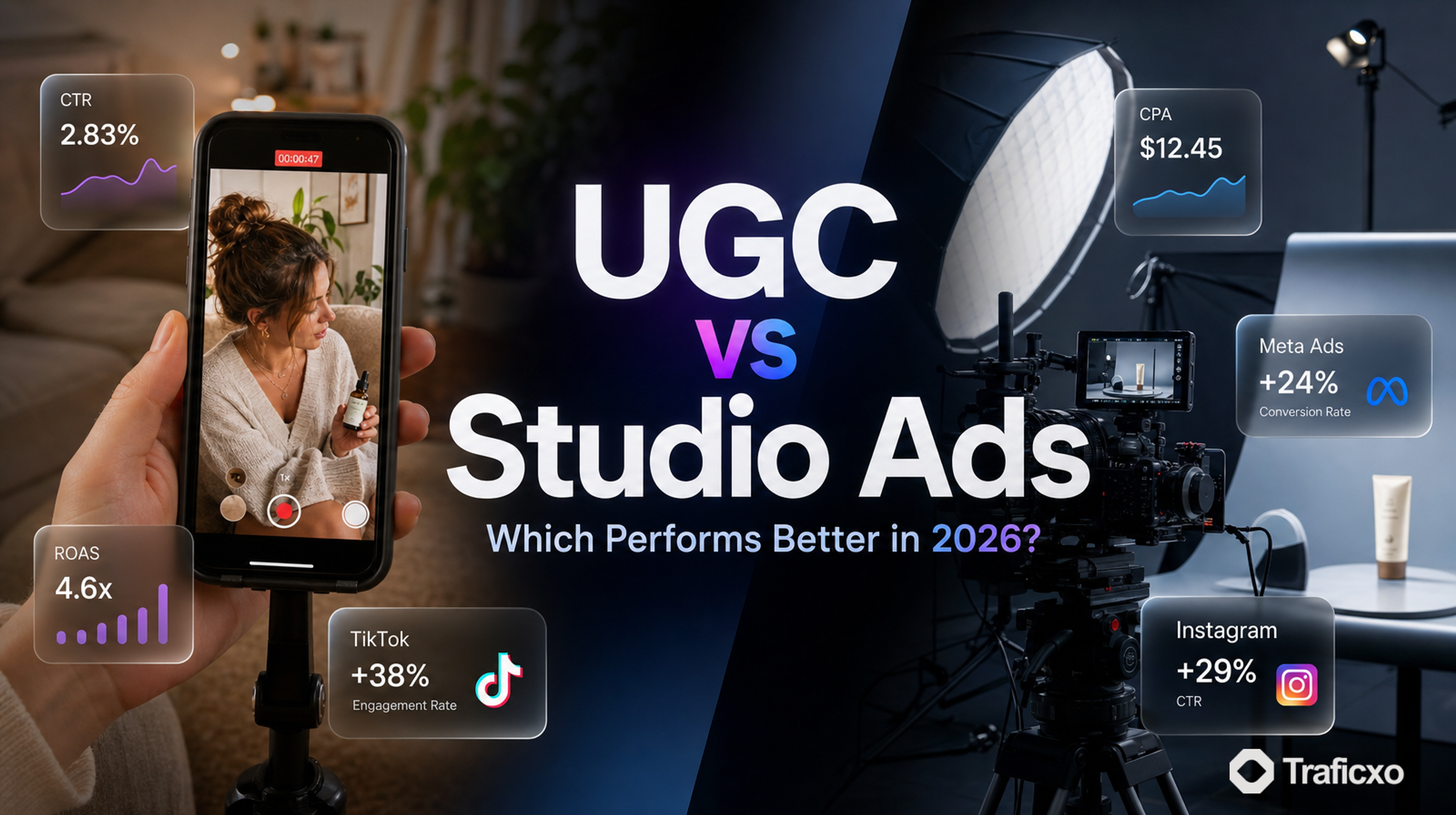
Short answer: For cold traffic on Meta and TikTok, UGC usually wins on click-through rate, cost per click, and return on ad spend. Studio ads win on brand perception, high-ticket trust, and anywhere polish is the point (YouTube long-form, connected TV, LinkedIn). The best-performing accounts don't pick one. They run both on purpose.
Now the detail worth reading.
First, what we're actually comparing
UGC ads are paid ads built from content that looks like a real person made it, selfie reviews, unboxings, "here's my honest take" clips shot on a phone. Most of it isn't accidental; brands hire creators to make authentic-looking content the brand then runs as an ad. It looks organic. It's not. That's the point.
Studio ads are professionally produced, real cameras, lighting, a crew, art direction, a script. Think product hero videos and brand films. They're built to make you feel something about the brand and to signal "we're a serious company."
One is optimized for the scroll. The other is optimized for the story.
The performance data
Every number below is drawn from published industry benchmarks and platform data so it can be verified.
- UGC-based ads see roughly 4x higher click-through rates and about 50% lower cost-per-click than traditional ads (Shopify data, reported by Insense and Billo).
- Emplifi's Q3 2025 benchmarks found social posts with UGC drove 10.38x higher conversion rates than posts without it (reported by Billo).
- On TikTok, creator-led UGC ads drove 70% higher CTR and 159% higher engagement than traditional brand ads at the same CPM (TikTok Creator Advantage report).
- Nielsen found 92% of consumers trust UGC more than other advertising; 79% say UGC influences what they buy.
- On cost: a professional studio video runs anywhere from $1,200 to $50,000, while a single UGC creator video typically costs $150 to $500 (some as low as roughly $59).
So it's settled, right? UGC wins?
Not so fast, and this is the part the ranking pages skip.
The part nobody selling UGC will tell you
In 2023, the agency Blue Finn noticed plain UGC ads were losing steam. Users had learned to spot the format. So they stopped copying "UGC" and started copying actual viral organic videos, and cut CPM from $70 to $35 while doubling ROAS (reported by Triple Whale).
The lesson isn't "UGC is dead." It's this: UGC's edge was never the low production quality, it was that it didn't feel like an ad. The moment your UGC starts looking like every other UGC ad, that edge disappears. Authenticity is the asset. "Phone footage" is just the delivery method.
That's why "just make cheap UGC" is bad advice. And it's why studio ads still earn their budget.
When studio ads genuinely win
Real scenarios, from experience, not theory:
- High-ticket or considered purchases. When someone's about to spend $2,000, a scrappy testimonial can lower trust. Buyers want signals that you're an established, legitimate brand. Polish is a trust cue here, not a liability.
- Brand-building campaigns. If the goal is recall and perception, not last-click sales, studio storytelling wins. Meta's own brand-lift work showed narrative-led video driving a +17-point lift in ad recall.
- Premium positioning. If your whole brand is "premium," ads that look cheap undercut your pricing power.
- YouTube long-form, connected TV, LinkedIn, and out-of-home. These placements reward production value. UGC feels out of place.
- Evergreen hero assets. A great studio film has a shelf life of years. Most UGC burns out in weeks.
When UGC wins
- Cold traffic on Meta, TikTok, Reels, and Shorts. Native beats polished in the feed, full stop.
- Direct-response and efficient CPA. Cheaper creative plus higher CTR usually means lower cost per acquisition.
- Creative testing at volume. This is UGC's real superpower. As platforms automate targeting, creative becomes the main lever you control, and you need lots of it.
- Speed. Brief a creator on Monday, launch by Friday.
- Ecommerce and DTC, especially beauty, wellness, and anything where "does this work for someone like me?" drives the purchase.
One more thing worth saying: paid ads are only half the growth picture. The brands that scale efficiently pair strong ad creative with organic visibility, so they're not renting every click. That's where SEO services and content marketing come in, ranking for the questions your buyers ask before they ever see an ad, and lowering your blended cost of acquisition over time.
Side-by-side comparison
| UGC Ads | Studio Ads | |
|---|---|---|
| Cost per asset | ~$150 to $500 | ~$1,200 to $50,000 |
| Turnaround | Days | Weeks |
| Feels like | A recommendation | An ad |
| Best for | Best for Performance, cold traffic | Branding, trust, premium |
| CTR in-feed | Higher | Lower |
| Creative testing | Excellent (high volume) | Limited |
| Shelf life | Short (weeks) | Long (months to years) |
| Best platforms | TikTok, Reels, Meta, Shorts | YouTube long-form, CTV, LinkedIn |
The strategy that actually works: run both
The brands winning in 2026 treat this as a system, not a debate:
- Use UGC to find winners. Test 8 to 15 variations across different hooks and angles. Change the first three seconds and hold everything else steady, that's where most performance is won or lost (about 65% of people who watch the first 3 seconds keep watching past 10).
- Use studio to build the brand. A few high-quality hero assets for retargeting, your site, and top-of-funnel brand work.
- Feed one into the other. Your winning UGC hooks should become the script for your next studio shoot. Your studio visuals should raise the quality ceiling on your UGC. They compound.
A sensible starting split for a growth-stage brand is roughly 70% UGC and 30% studio, shifting toward studio as your average order value and brand equity go up.
This is exactly the kind of system Traficxo builds end to end: our UGC ad production and video services teams handle everything from high-volume creator content and hook testing to the polished studio hero assets that carry your brand. You get both engines feeding each other, not two disconnected line items.
A quick word on AI UGC
AI-generated UGC can cut production cost by up to 95% and turn weeks into minutes. It's genuinely useful for testing dozens of hook variations fast, one industry expert says it's "60 to 70% there" and that you should test 30 to 40 variations to find a winner.
Two cautions: 68% of consumers are worried about fake content, and Meta, TikTok, and YouTube now require you to disclose AI-generated video. Use AI to test at scale; keep real humans for the trust-building work. Skipping disclosure risks both penalties and brand damage.
Common mistakes I still see
- Treating it as UGC versus studio instead of UGC and studio.
- Over-polishing UGC until it looks like an ad again, killing the one thing that made it work.
- Judging a brand-building studio ad by last-click ROAS.
- Running one creative and expecting it to scale.
- Ignoring the hook. The first three seconds decide everything.
- Never refreshing. Even great UGC fatigues; about 85% of social video is watched with sound off, so if your hook needs audio, you've already lost half your audience.
Conclusion
UGC vs Studio Ads isn't a winner-take-all fight. UGC is your performance and testing engine. Studio is your brand and trust layer. The account that wins isn't the one with the single best ad, it's the one with the best creative system feeding both.
If you're spending real money on paid social and only running one of these, you're leaving performance on the table. At Traficxo, we build that full system, UGC for efficient CPA and volume testing, studio for brand, and connect it to the numbers that matter. Book a free creative strategy call.
How Traficxo helps
As a full-service digital marketing agency, we cover the whole engine so nothing works in isolation:
- UGC ad production: creator sourcing, briefing, and high-volume creative testing for Meta, TikTok, and Reels.
- Video services: polished studio hero videos and brand films for retargeting, YouTube, and premium placements.
- SEO services: ranking for the searches your buyers make before they ever see an ad, to lower your blended cost of acquisition.
- Content marketing: turning that organic visibility into trust and demand that your paid ads then convert.
Explore Services & Solutions
Video Production Hub
Access our comprehensive vertical strategies, core processes, and expert resources.
View service hub Specialized SolutionProfessional Video Editing
Scale your brand narrative with explainer videos, social media reels, and motion graphics.
Learn moreReady to grow your digital presence?
Connect with our execution specialists for a customized roadmap.